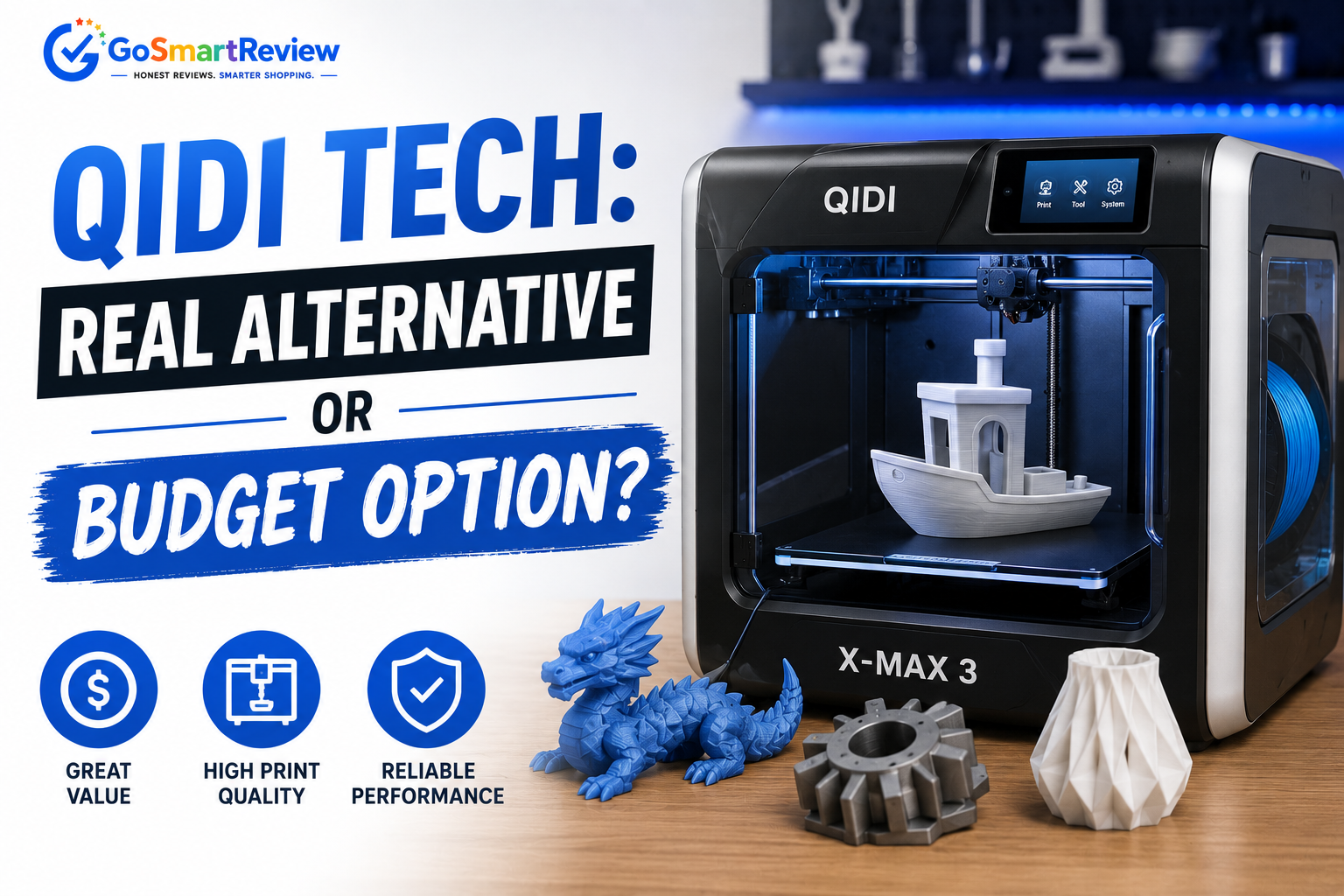
Is QIDI Tech a real alternative to Bambu Lab and Creality, or just the budget option?
QIDI Tech has been quietly building engineer-led FDM printers while Bambu Lab and Creality dominate the headlines. With coverage from TechRadar, Tom's Hardware, and CNET, plus a growing multi-material ecosystem of its own, it's earned more attention than "budget alternative" gives it credit for. Here's where it actually stands.
What is QIDI Tech?
QIDI Tech is an FDM 3D printer manufacturer built by a team of engineers, offering printers, filaments, and accessories spanning beginner to industrial-grade use. Beyond the printer hardware itself, the brand runs its own slicer software (QIDI Studio), a remote monitoring app (QIDI Link), and an expanding filament catalog that goes well past basic PLA into carbon-fiber and glass-fiber reinforced engineering materials.
What you get, what you give up
- Independently reviewed and covered by respected tech outlets (TechRadar, Tom's Hardware, CNET), not just marketing claims
- Filament range extends into genuine engineering-grade materials — PEEK-adjacent PPS-CF, carbon-fiber nylon, glass-fiber PETG — that many consumer brands don't offer at all
- QIDI Box brings 16-color multi-material printing to the ecosystem, directly competing with Bambu Lab's AMS and Creality's CFS
- Active, vocal community across Reddit, Discord, and Facebook, meaning troubleshooting help is easy to find
- Own-brand slicer (QIDI Studio) and remote monitoring app rather than relying entirely on third-party software
- A published warranty policy and dedicated after-sales support page, not just a generic contact form
- Smaller community and ecosystem than Bambu Lab's MakerWorld, which has over a million shared models and a mature rewards program
- Multiple overlapping series (Q, X, I) can make it harder for a first-time buyer to know which printer actually fits their needs
- Software polish, while solid, is generally considered a step behind Bambu Studio's refinement by most independent reviewers
- As a smaller brand, third-party accessory and mod support is less extensive than for the market leaders
Which QIDI printer actually fits your budget
What sets the material range apart
Common filaments
PLA Basic, PETG Basic, and Rapido variants cover everyday printing at accessible prices, including wood-fill, silk, and metallic finishes for aesthetic prints.
High performance materials
ASA, TPU-Aero, PLA-CF, and glass-fiber ABS give functional-part printers real strength and flexibility options beyond basic plastics.
Industrial grade composites
Carbon-fiber and glass-fiber reinforced nylons, PPS-CF, and fire-retardant PC/ABS target genuinely demanding engineering applications — not a common offering at this price tier.
Built-in filament guide
A published filament selection guide helps match material to project without needing to research specs from scratch.
When to buy — and when to look at the big two
✔ QIDI Tech is a great fit if you
- Want to eventually print engineering-grade materials (carbon fiber, PEEK-adjacent composites) without switching brands
- Are comfortable with a slightly smaller, still-active community versus the largest players
- Want independent third-party validation (TechRadar, Tom's Hardware, CNET) before buying, not just brand marketing
- Are shopping in the $400–$1,050 range and want a real alternative to compare against Bambu Lab and Creality
✘ Consider a market leader if you
- Want the single largest model-sharing community (Bambu Lab's MakerWorld)
- Prioritize the most polished, beginner-friendly slicer software above all else
- Need the widest possible third-party mod and accessory ecosystem
QIDI Tech vs. Bambu Lab and Creality
| Brand | Entry price | Flagship price | Best for |
|---|---|---|---|
| QIDI Tech | $399 (Q2C) | $1,049 (Max4) | Engineering-grade materials, media-validated value |
| Bambu Lab | ~$489 (A1 combo) | ~$799+ (P2S combo) | Most polished ecosystem, largest community |
| Creality | ~$399 (K1C) | ~$1,049+ (K2 Pro combo) | Largest build volumes, Klipper openness |
Quick answers
Which QIDI printer should a beginner start with?
The Q2C at $399 is the most affordable current model and positioned as an entry point, while the Q2 at $499 adds a larger build volume and touchscreen for a modest step up.
Does QIDI Tech support multi-color printing?
Yes — the QIDI Box add-on supports up to 16-color multi-material printing when paired with compatible printers, similar in concept to Bambu Lab's AMS and Creality's CFS.
Can I print carbon-fiber or engineering materials?
Yes — QIDI's Industrial Grade Composites line includes carbon-fiber and glass-fiber reinforced nylons, PPS-CF, and fire-retardant PC/ABS, which isn't common at this price tier.
Is there an active community if I need help?
Yes — QIDI Tech maintains an active Reddit community, Discord server, and Facebook Group, alongside an official wiki and support center.
8.7/10 — A genuine third option, not just a cheaper copy of the market leaders
It's easy to lump every non-Bambu, non-Creality printer brand into "budget alternative," but QIDI Tech's engineering-grade filament range and real third-party media coverage suggest it's building something more deliberate than a knockoff. If you want a printer that can grow from PLA hobby prints into genuinely demanding composite materials without switching ecosystems, it deserves a spot on your shortlist alongside the two bigger names.
Shop QIDI Tech →